












.png?width=300&name=HC_Blogtitel_2500x525px_PowerZones2%20(1).png)
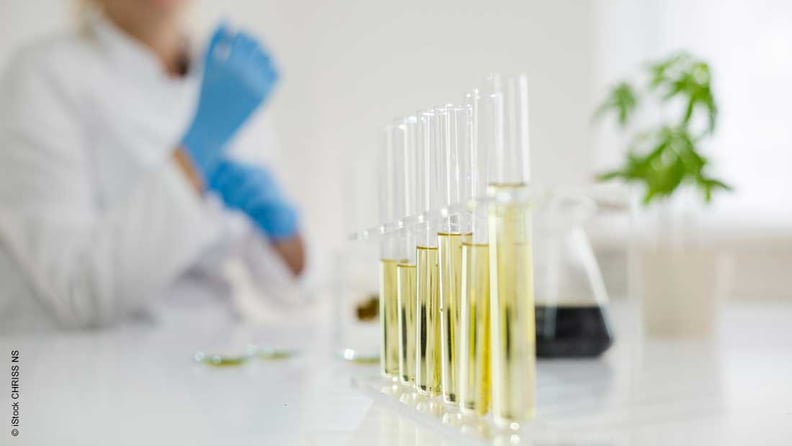
CBD products have long since become part of our everyday lives. Whether as a pharmaceutical or lifestyle product, dietary supplement or in cosmetics. High quality is important, as impurities can lead to a loss of effect, taste and tolerability. Which extraction process is used plays a decisive role, along with other factors. Here you can find out why CBD production with high-purity hydrocarbons ensures the best quality.
Cannabidiol (CBD) has attracted a lot of attention in recent years due to its health benefits. It is used to relieve ailments such as chronic pain, anxiety and sleep disorders.
Good to know!
In many countries the possession and consumption of products containing THC is regulated, while products containing CBD might be legally available as long as their THC content is below a certain limit. These different legal regulations reflect the different areas of application and risks of the two substances. |
CBD production consists of many steps
The production of CBD takes place in a multi-stage process. First, hemp plants containing CBD are grown under controlled conditions. After harvesting, the plants are dried and crushed to extract the CBD-containing parts.
Subsequently, the CBD is extracted, often using hydrocarbons, which is considered particularly clean and efficient. The CBD is dissolved from the plant material and then purified from unwanted impurities and residues. The extracted CBD oil can then be processed into various products such as tinctures, capsules, creams and foods.
The quality of CBD products: This is what you should look out for
Nowadays, CBD oils are offered in many varieties and concentrations. In order to recognise the highest quality among the abundance of products, the following factors provide guidance:
- Varietal purity
In order to extract CBD from the plants, mainly hemp varieties are bred in which the CBD content is particularly high and the THC content is low. In total, there are about 50 varieties that guarantee a very high CBD content. They are defined in a → seed catalogue of the EU. - THC content indication
Quality-conscious CBD manufacturers indicate the THC content on the packaging, as it is regulated by law in most countries. - Ingredient disclosure
A listing and disclosure of the ingredients also speaks for a producer who focuses on quality and transparency. - Independent analysis
Tests and analyses by independent laboratories or institutions show that CBD manufacturers pay attention to high quality and that their CBD products also stand up to external testing.
- Production process
The CBD production process is decisive for the quality and thus whether it is as free as possible from impurities.
Find out more in this blog article about possible CBD production methods:
Excursus: What is the difference?
CBD oil is extracted from the cannabinoid cannabidiol and should therefore have the lowest possible THC content. Cannabidiol is mainly extracted from the hemp flowers and leaves of potentised female hemp.
CBD isolate also consists of cannabidiol. However, this is isolated during the manufacturing process, resulting in crystals that consist mostly of cannabidiol. The product is thus offered as CBD isolate or CBD oil with crystals.
Hemp seed oil or hemp oil is produced by cold pressing hemp seeds and does not contain CBD or THC. Due to its many useful fatty acids such as linolenic acid and omega-3 fatty acids, it is particularly suitable as an edible oil.
Stay informed with our Blog!Subscribe to our blog and benefit from regular information on valuable hydrocarbon topics:
|

The CBD production process is decisive for the quality of the oil
The method of CBD production is largely responsible for the quality of the oils. One of the most commonly used methods is extraction with solvents. In this process, the plant material is repeatedly flushed with fresh solvent in a special apparatus until it is exhausted. Finally, the solvent is distilled off and the last traces are removed under reduced pressure.
In practice, various aliphatic hydrocarbons (alkanes) are used as solvents. In principle, CBD extraction is possible using a range of alkanes - from propane and butane through pentane to heptane.
Depending on the solvent used, the composition of the extract may vary slightly, for example in terms of terpene profiles or accompanying compounds. n-Pentane with a purity of 95% or 99% can therefore also be used for extraction, provided that the corresponding equipment and process control are designed for this purpose.
However, to ensure consistently high product quality, it is crucial that the solvent used meets defined specifications.
Solvents with pharmaceutical quality standard - n-heptane
The high-purity 95- or 99-percent n-heptane is ideally suited for CBD production. This solvent is also used in the production of active pharmaceutical ingredients (APIs), where the highest quality standards are applied!
CBD oil manufacturers benefit from n-heptane for many reasons:
- Extraction with hydrocarbons such as n-heptane is a well-known and easy-to-perform process.
- n-heptane convinces by its quality with pharmaceutical standard.
- Haltermann Carless offers n-heptane qualities with 95% and 99% purity.
- Since the natural substance CBD is not particularly soluble in water, paraffinic solvents are a good choice.
Looking for a reliable solvent supplier? Haltermann Carless is one of the chemical companies that specialises in the production of paraffinic solvents with high purities. At its Speyer site in Germany, the company produces high-quality solvents such as n-heptane for the pharmaceutical industry.
Conclusion: The right solvents for high-quality CBD production
CBD production involves a multi-stage process in which the choice of solvent is particularly crucial to the quality of the end product. Various aliphatic hydrocarbons (alkanes) such as propane, butane, pentane or heptane are generally suitable for extraction, as they can efficiently dissolve the natural compound CBD from the plant material.
Depending on the solvent used, the composition of the extract may vary slightly. To ensure consistently high quality and reproducible results, it is therefore essential to have defined specifications and a high purity of the products used.
The high-purity solvent n-heptane is particularly suitable for clean and efficient extraction. This allows the production of premium CBD oil, which can be further processed into tinctures, creams or foods. When producing CBD, you should trust high-quality solvents and reliable suppliers such as Haltermann Carless.
As a long-standing supplier to the pharmaceutical industry, Haltermann Carless experts know what is important when quality, reliability and delivery capability are required. Find out more about our products and services in the following blog posts:
-
Haltermann Carless: Find the right products for your industry!
- Critical solvent properties for the pharmaceutical industry
- Pharmaceutical industry: How to avoid contamination in solvents
FAQ: Frequently asked questions about CBD production and solvents
What solvents are used in CBD production?
In practice, various solvents are used, including CO₂, ethanol, and aliphatic hydrocarbons such as propane, butane, pentane, or heptane. The choice of solvent affects the efficiency of the extraction process as well as the composition of the resulting CBD extract.
Why are high-purity solvents so important in CBD production?
High-purity solvents play a crucial role in the quality of the final product. Impurities in the solvent can end up in the extract and compromise the CBD product’s efficacy, taste, or tolerability. Therefore, defined specifications and consistent quality are essential.
Why is n-heptane often recommended for CBD extraction?
n-heptane stands out for its high purity, good extraction properties, and widespread use in the pharmaceutical industry. It enables efficient and reproducible extraction and meets high-quality standards that are also relevant in the production of CBD products.
Does the solvent affect the quality of the CBD extract?
Yes, the solvent used can influence the composition of the extract, for example with regard to cannabinoids, terpenes, and accompanying compounds. Therefore, selecting the appropriate solvent is a key factor in the quality of the final product.
Can CBD also be extracted with pentane?
Yes, in principle, CBD can also be extracted with pentane. Like propane, butane, and heptane, pentane belongs to the group of alkanes and is suitable as a solvent for the extraction of cannabinoids. However, this requires that the technology and process control of the equipment used are designed for this purpose and that the solvent meets the necessary purity standards.
This article was first published on 07.01.2022, revised on 23.08.2024 and 07.04.2026.