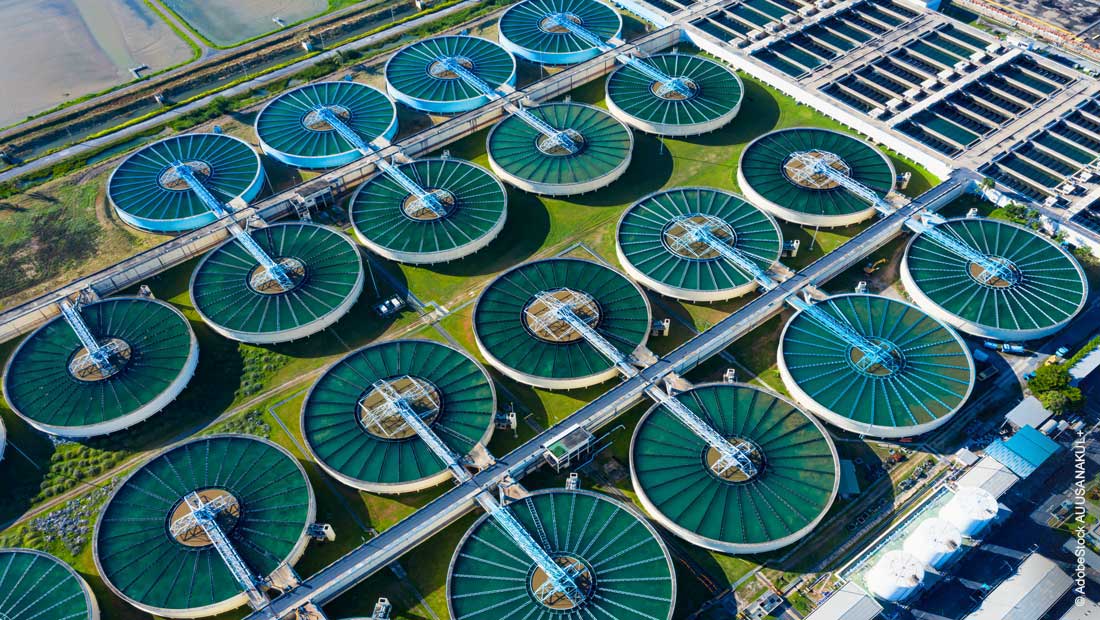


















Flocculation is an important process in waste water treatment plants. Various flocculants are used in this process. They are responsible for causing solids to agglomerate into larger clusters so that they can be better separated from the water to be purified. Haltermann Carless offers new low-viscosity base oils for water treatment. As a carrier fluid for polyacrylamide emulsions, Pilot® H products are characterised by their technical improvements and, above all, by their low aromatic content and biodegradability. Find out more about the advantages of our new Pilot® oils for flocculants.
Pilot® oils support flocculants in their central task of water treatment
Water treatment has the simple goal of removing unwanted impurities from the water - but behind this are complex processes and procedures. This is because removing particularly fine, dissolved and suspended substances is a multi-stage, interlinked chemical process. Flocculation plays a central role in this process.
- Often, flocculants are first added to bring together individual colloidal particles to form larger aggregates or agglomerates (coagulation). Iron (III) salts, aluminium sulphate or sodium aluminate, among others, are used.
- In order to achieve even better separation of the flocs, flocculants are used, for example based on polyacrylamides, which combine the flocs into larger and heavier units. This results in faster settling. Flocculants act as "accelerators" here.
Pilot® oils are convincing in polymer flocculants
In addition to dosing expertise, a flocculation process also requires particularly high-quality products. This leads to greater efficiency and cost savings, for example when polyacrylamides are added in-line as an emulsion and can thus accelerate the water treatment process.
Haltermann Carless offers a modern portfolio of low-viscosity base oils. As carrier fluids for polyacrylamide emulsions, the new Pilot® H oils offer formulators of water treatment chemicals optimum properties.
Pilot® H oils for flocculants fulfil all regulatory criteria and provide excellent technical properties:
- High purity
- Colourless and odourless
- Low aromatic content
- Chemically inert
- Excellent dissolving behaviour
- Flash points >70 °C and defined boiling ranges
- No VOC content
- Readily biodegradable
- Suitable for indirect food contact according to FDA 21 CFR Ch. 178.3620 (B) and German BfR XXXVI
For water treatment we offer the following Pilot® H oils:
- Pilot® 250H
- Pilot® 275H
- Pilot® 300H
- Pilot® 300H+
- Pilot® 400H
Stay informed with our Blog!Subscribe to our blog and benefit from regular information on sustainable hydrocarbons, research & development and supply chain management:
|

New manufacturing process improves technical and ecological properties of Pilot® oils for flocculants
The new Pilot® H oils for flocculants are produced in a modern hydrogenation plant at our production site in Speyer, Germany. They offer manufacturers in the field of water treatment chemistry advantages through improved technical and ecological properties. In addition, the reduced aromatic content and easy biodegradability are decisive improvements that are of interest for the sensitive area of water treatment.
Pilot® H oils properties
|
Typical data |
Method |
Pilot |
Pilot |
Pilot |
Pilot |
Pilot |
|
Appearance
|
Visual
|
Clear & colorless
|
Clear & colorless
|
Clear & colorless
|
Clear & colorless
|
Clear & colorless
|
|
Color (Saybolt)
|
ASTM D156
|
30
|
30
|
30
|
30
|
30
|
|
Initial Boiling Point (IBP)
|
ASTM D86
|
220 °C
|
235 °C
|
250 °C
|
260 °C
|
280 °C
|
|
Final Boiling Point (FBP)
|
ASTM D86
|
243 °C
|
275 °C
|
295 °C
|
320 °C
|
320 °C
|
|
Density
@ 15 °C
|
EN ISO 12185
|
820 kg/m3
|
820 kg/m3
|
820 kg/m3
|
820 kg/m3
|
820 kg/m3
|
|
Flash Point (PM)
|
EN ISO 2719
|
min. 88 °C
|
min. 100 °C
|
min. 110 °C
|
min. 110 °C
|
min. 130 °C
|
|
Kinematic Viscosity
@ 40 °C
|
DIN 53015
|
1.9 mm²/s
|
2.5 mm²/s
|
3.0 mm²/s
|
4.5 mm²/s
|
4.5 mm²/s
|
|
Aromatics (UV)
|
HM-14-Labor
|
max. 2000 ppm
|
max. 1000 ppm
|
max. 1000 ppm
|
max. 1000 ppm
|
max. 1000 ppm
|
|
Pour Point
|
DIN ISO 3016
|
|
max. -40°C
|
max. -30°C
|
max. -20°C
|
max. -10°C
|
More information on our Pilot® oils can be found in our → Product Database or in the following blog articles:
- Pilot® Oils from Haltermann Carless score with very low aromatic content
- Pilot® Oils: New qualities for silicone sealant manufacturers
- The advantages of NSF certification for low-viscosity base oils
Conclusion: Improving water treatment performance with Pilot® oils for flocculants
Polymer flocculants make an important contribution to water treatment. They can achieve improvements in process acceleration as well as in the cost structure. As carrier fluids for polyacrylamide emulsions, the new Pilot® H oils from Haltermann Carless are important building blocks in flocculants. With improved properties such as a low aromatic content, biodegradability, high purity and excellent dissolving behaviour, they are ideally suited for water treatment in municipal and industrial wastewater treatment plants.
FAQs on flocculants, flocculation aids and Pilot® oils
1. What is the difference between flocculants and flocculation aids?
Flocculants (coagulants) neutralise the electrical charge of very fine particles in water, enabling them to come together. Typical examples include iron or aluminium salts. Flocculation aids, on the other hand – often based on polyacrylamides – bind these particles into larger, more stable flocs. This improves sedimentation and accelerates the overall separation process.
2. Why are polyacrylamide emulsions used in water treatment?
Polyacrylamides are highly effective because they form long molecular chains that link particles together. In emulsion form, they can be dosed easily and distributed quickly throughout the process. This increases flocculation efficiency and allows for faster and more complete separation.
3. What role do base oils play in flocculation?
Base oils act as carrier fluids for polymer-based flocculation aids such as polyacrylamide emulsions. They have a significant impact on the stability, dosing behaviour and processing characteristics of the formulation. High-purity, low-viscosity oils ensure even distribution and reliable performance in the treatment process.
4. Why is a low aromatic content important in base oils?
A low aromatic content improves both environmental compatibility and occupational safety. Aromatics can be harmful to health and are undesirable in sensitive applications such as water treatment. Highly refined, low-aromatic oils therefore represent the current state of the art.
5. Are Pilot® H oils suitable for use in sensitive applications?
Yes, Pilot® H oils meet relevant regulatory requirements and are approved for applications involving indirect food contact (e.g. in accordance with FDA and BfR guidelines). They are also colourless, odourless and readily biodegradable, making them particularly suitable for sensitive applications.
6. What are the practical benefits of low-viscosity base oils?
Low-viscosity oils are easier to handle and dose, especially in continuous (inline) processes. They support rapid distribution of active substances and help to improve the efficiency of water treatment while reducing operating costs.
This article was first published in March 2024 and revised in April 2026.